

Patents
Literature
38results about How to "Efficient and reliable control" patented technology
Efficacy Topic
Property
Owner
Technical Advancement
Application Domain
Technology Topic
Technology Field Word
Patent Country/Region
Patent Type
Patent Status
Application Year
Inventor
Resonance-type power electronic current transformer and current transformer device
ActiveCN103441691AHigh-efficiency energy transfer and intelligent controlLow costEfficient power electronics conversionAc-dc conversionPower gridThree-phase
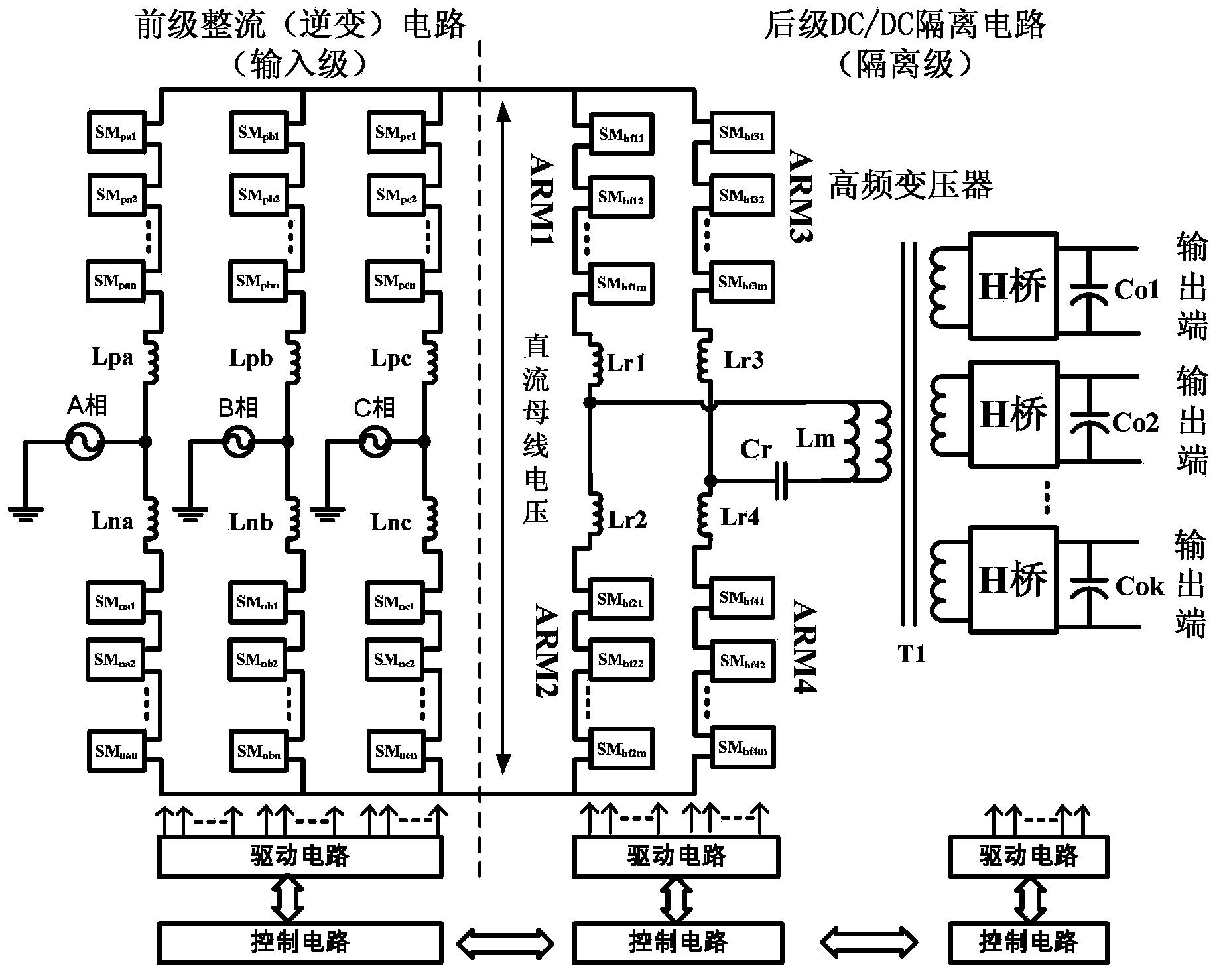
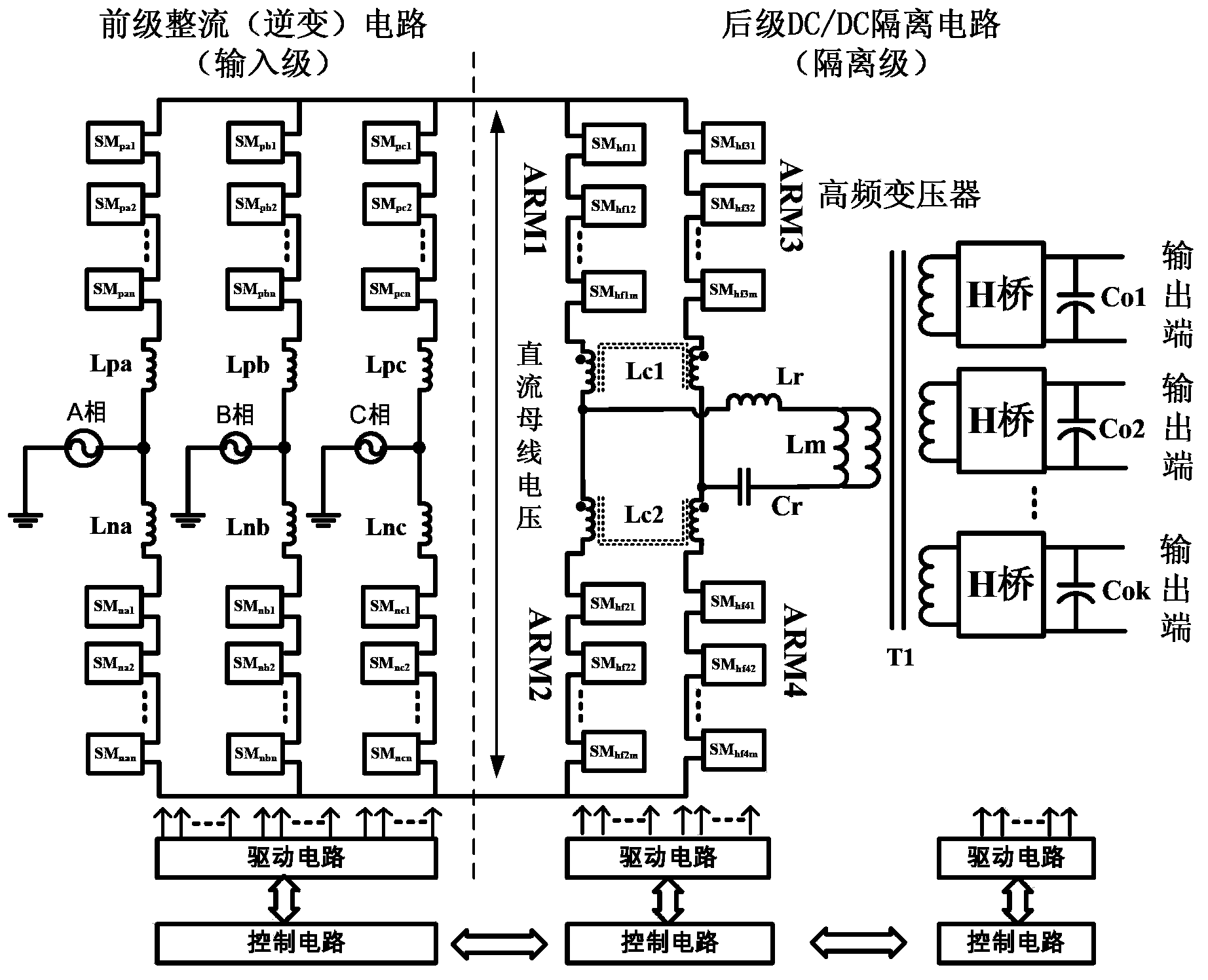
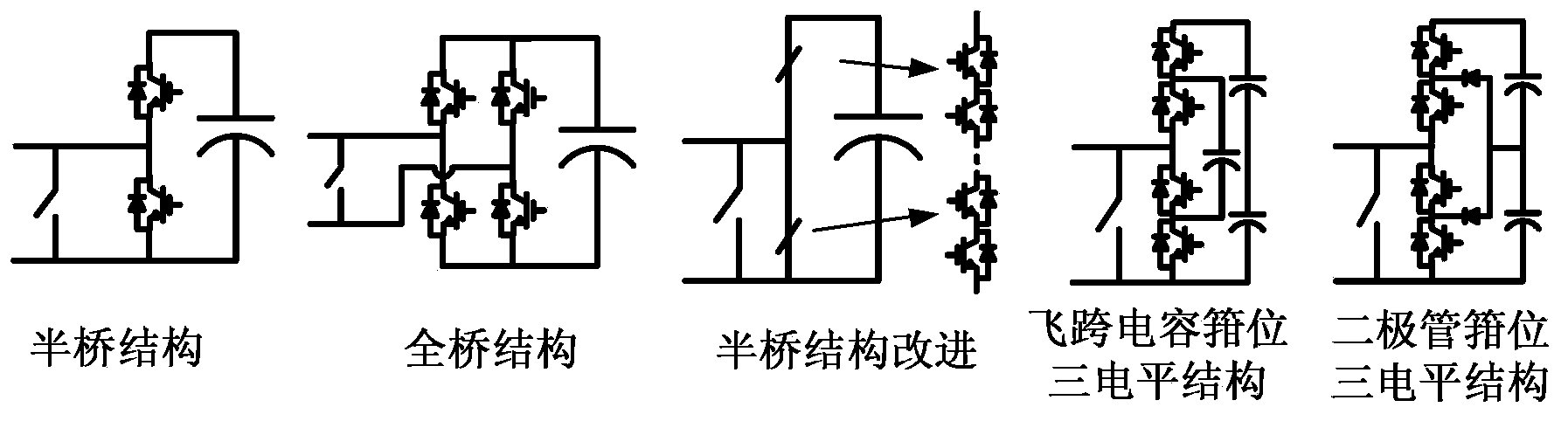
The invention relates to the technical field of power electronic current transformers, and provides a resonance-type power electronic current transformer and a current transformer device. The current transformer comprises an input-stage rectifying circuit and a rear-stage DC / DC circuit. The input-stage rectifying circuit comprises three bridge arms. Each bridge arm is composed of an upper half bridge arm body and a lower half bridge arm body. The midpoints of the bridge arms are connected with three phases of a high-voltage alternating-current power grid respectively. Each half bridge arm body comprises n module units. Ports of the module units are connected in a head-to-tail mode to form a bridge arm structure. Due to the high-frequency isolation of the input side and the output side, a heavy lower-frequency transformer is removed, and meanwhile efficient energy transmission and intelligent control are achieved. Harmonic wave transmission between different power grids and mutual influences caused by failures of the different power grids can be intercepted, meanwhile, the range of the output voltage is wide, continuous adjustment of the current and the voltage can be achieved, system operation information of the current transformer is easy and convenient to collect, mutual communication can be achieved among a plurality of current transformer systems, and the intelligent power grid is obtained.
Owner:ZHEJIANG UNIV
Frost-less air-source heat pump hot water unit and proportional-integral-differential control method for same
InactiveCN103245151AWell mixedImprove performanceFluid heatersCorrosion preventionProportional integral differentialEngineering
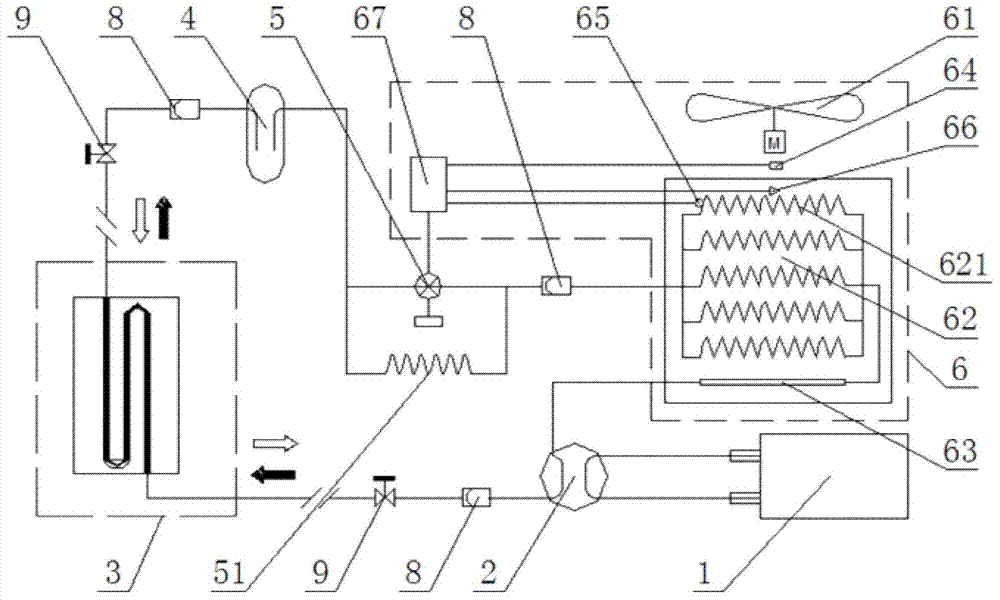
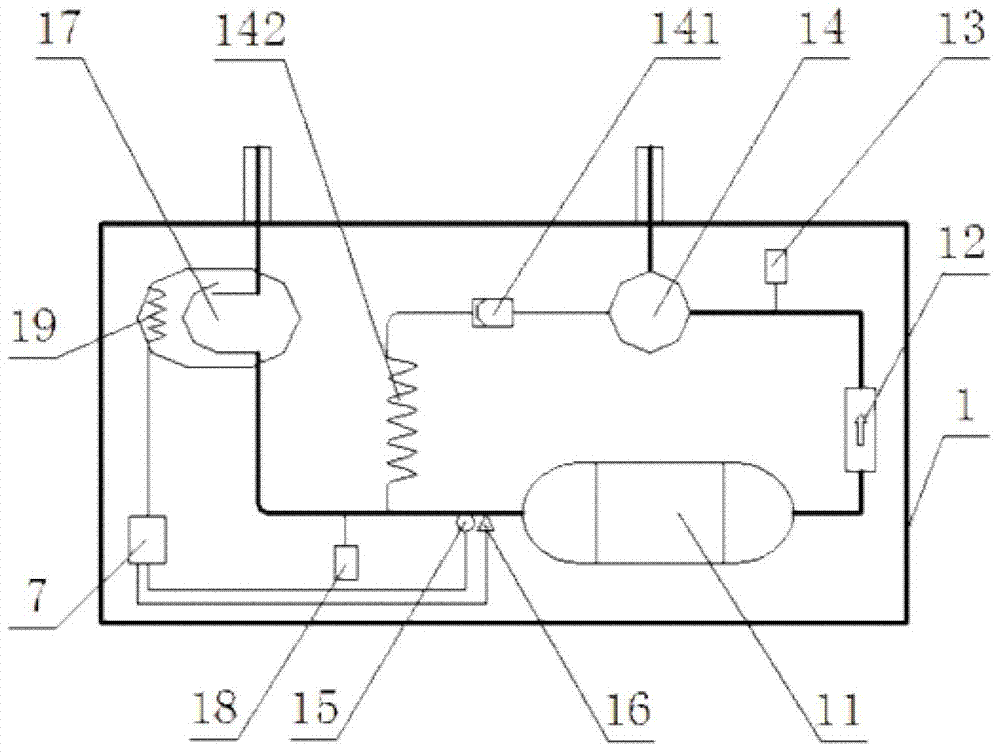
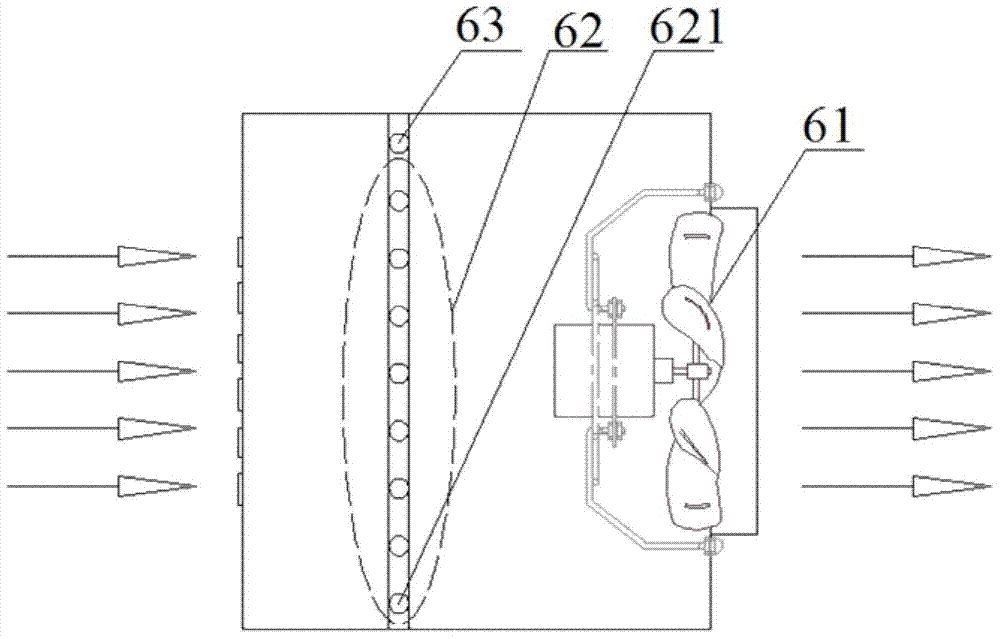
The invention discloses a frost-less air-source heat pump hot water unit and a proportional-integral-differential control method for the same. The proportional-integral-differential control method includes performing computation according to received air temperature and humidity parameters, received air pressure parameters and received surface temperature parameters of an evaporator when outdoor temperature parameters which are transmitted by a temperature and humidity sensor and are received by a computation controller are lower than 0 DEG C, controlling the opening of an electronic expansion valve according to a computation result and regulating the surface temperature of the evaporator by means of increasing or reducing the opening of the electronic expansion valve so that the surface temperature of the evaporator is constantly higher than a frost formation point; and enabling a silicon-controlled power regulator to judge a suction superheat degree of a compressor according to received suction temperature and suction pressure of the compressor, increasing or reducing the power of an electric heater and maintaining that the suction superheat degree of the compressor only varies within a set value range. The frost-less air-source heat pump hot water unit and the proportional-integral-differential control method have the advantage that adjustment for the opening of the electronic expansion valve is matched with adjustment for the power of the electronic heater, so that the purpose of maintaining safe and efficient running of a system is achieved.
Owner:NANJING NORMAL UNIVERSITY +1
Control method and system for cross-platform mobile network terminal
ActiveCN102685254ASolve remote business processingEfficient and reliable controlSubstation equipmentTransmissionHTML5Network termination
The invention discloses a control method for a cross-platform mobile network terminal, which comprises the following steps of: S1, sending a request to a service terminal by a mobile network terminal; S2, generating a control code and sending to the mobile network terminal by the service terminal after receiving the request of the mobile network terminal, wherein the control code is used for controlling hardware equipment of the mobile network terminal, which is realized by using the techniques of HTML5, JavaScript and json; S3, receiving the control code from the service terminal by the mobile network terminal, executing the control code to control the hardware equipment of the mobile network terminal, and obtaining the parameters collected by the hardware equipment; S4, sending the parameters collected by the hardware equipment to the service terminal by the mobile network terminal; and S5, receiving the parameters collected by the hardware equipment by the service terminal and interacting with the database of the service terminal for business processing. The method disclosed by the invnetion realizes control of different mobile network platforms with lower cost.


Owner:SHENZHEN POWERSOFT TECH
Multi-scale integrated visual high-flux automatic calculation process and data intelligent system
ActiveCN112102887AFacilitate communicationSimple structureChemical property predictionChemical data visualisationData analysis systemGenetic engineering
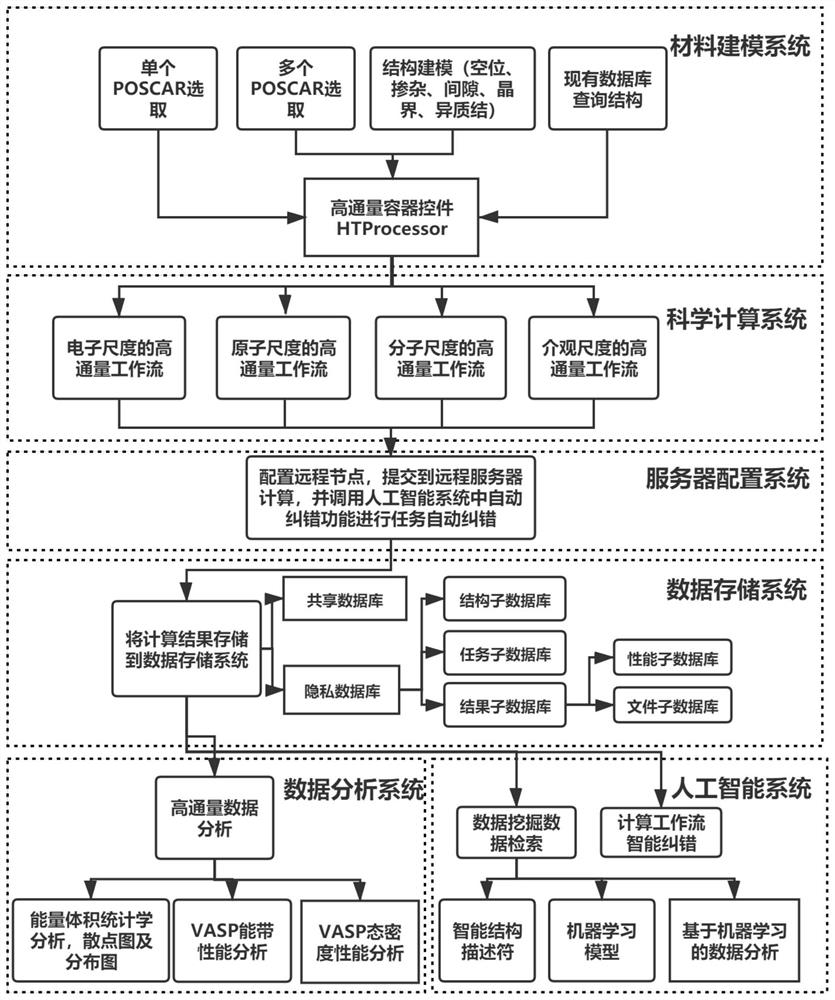
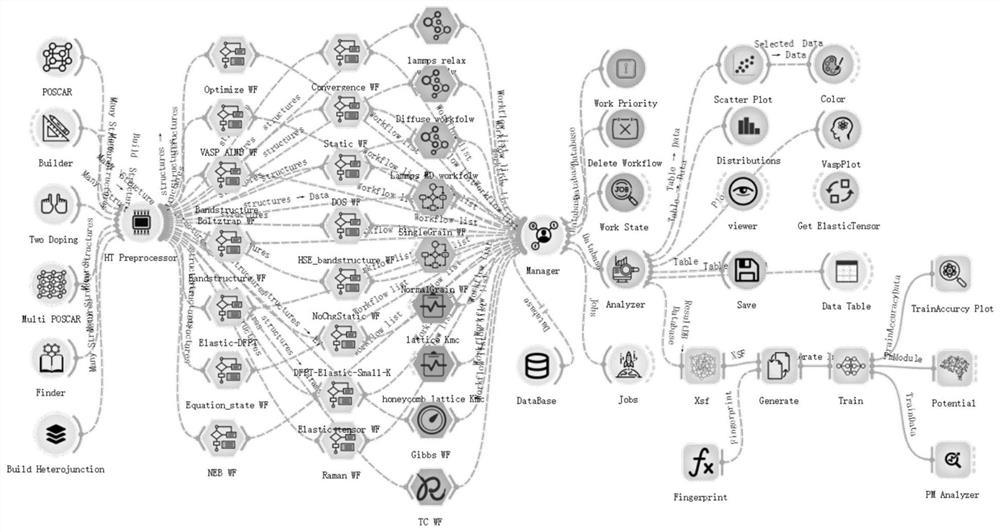
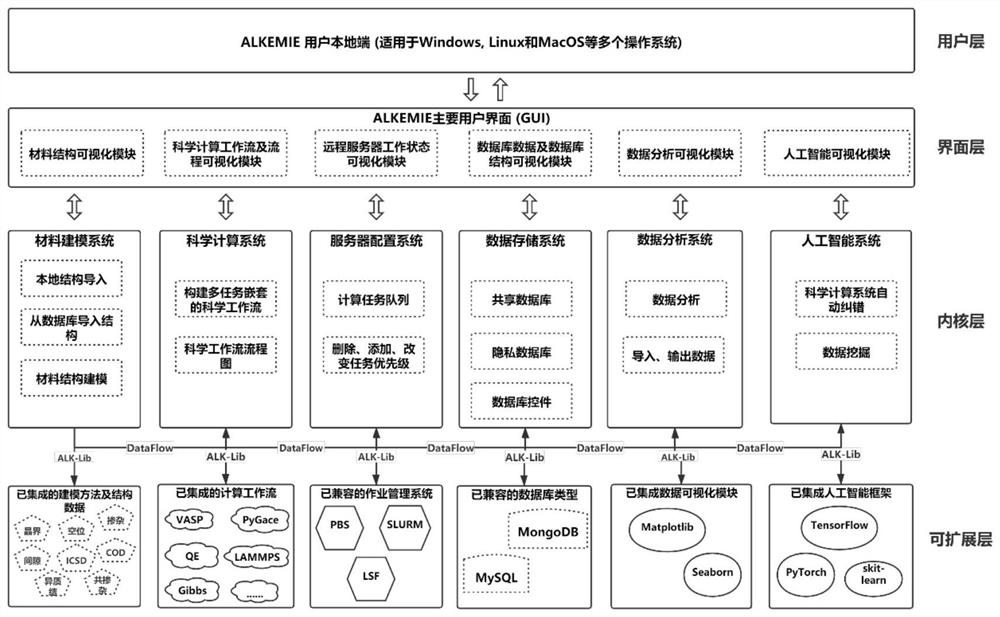
The invention belongs to the field of material genetic engineering, multi-scale simulation and material big data, and relates to a multi-scale integrated visual high-flux automatic calculation processand data intelligent system, which comprises a material modeling system, a scientific calculation system, a server configuration system, a data storage system, a data analysis system and an artificial intelligence system. According to the method, an automatic construction method of a material complex model, various material calculation simulation methods with different scales, various types of material databases, a material performance analysis technology and a data mining technology based on artificial intelligence are combined, and 1000-magnitude material high-flux calculation simulation can be automatically carried out; material calculation simulation of multiple scales such as an electronic scale, an atomic scale, a molecular scale and a mesoscopic scale can be carried out, and errorspossibly occurring in the calculation process can be automatically corrected; all calculated structural data, intermediate metadata and result data can be stored in various types of material databases, so that a user can conveniently inquire and carry out data mining analysis.
Owner:BEIHANG UNIV
Control Device for Vehicle Ac Generator
ActiveUS20080284386A1Efficient and reliable controlEfficient and reliableEmergency protective circuit arrangementsDynamo-electric converter controlEngineeringActive switch
A highly reliable control device for an AC generator without using a transistor and diode having high withstand voltage is provided.A control device for a vehicle AC generator including a voltage control circuit that controls an output voltage of a rectifying circuit connected to a stator coil to a substantially constant level has a first active switch having its one end connected to one end of the field coil and having its other end connected a negative output terminal of the rectifying circuit, a second active switch having its one end connected to a positive output terminal of the rectifying circuit and having its other end connected to the other end of the field coil, a first passive switch connected between the negative output terminal of the rectifying circuit and a connecting point of the second active switch and the field coil, and a second passive switch connected between the positive output terminal of the rectifying circuit and a connecting point of the first active switch and the field coil, and the first and second active switches are on / off-controlled independently of each other.


Owner:MITSUBISHI ELECTRIC CORP
Control device for vehicle AC generator
ActiveUS7498776B2Efficient and reliable controlIncrease heightEmergency protective circuit arrangementsDynamo-electric converter controlStator coilEngineering


Owner:MITSUBISHI ELECTRIC CORP
Control and regulation method of stitch length for sewing machinery
ActiveCN109989185AAchieve regulationRealize front and rear dense seamsProgramme-controlled sewing machinesWork-feeding meansElectronic control systemEngineering
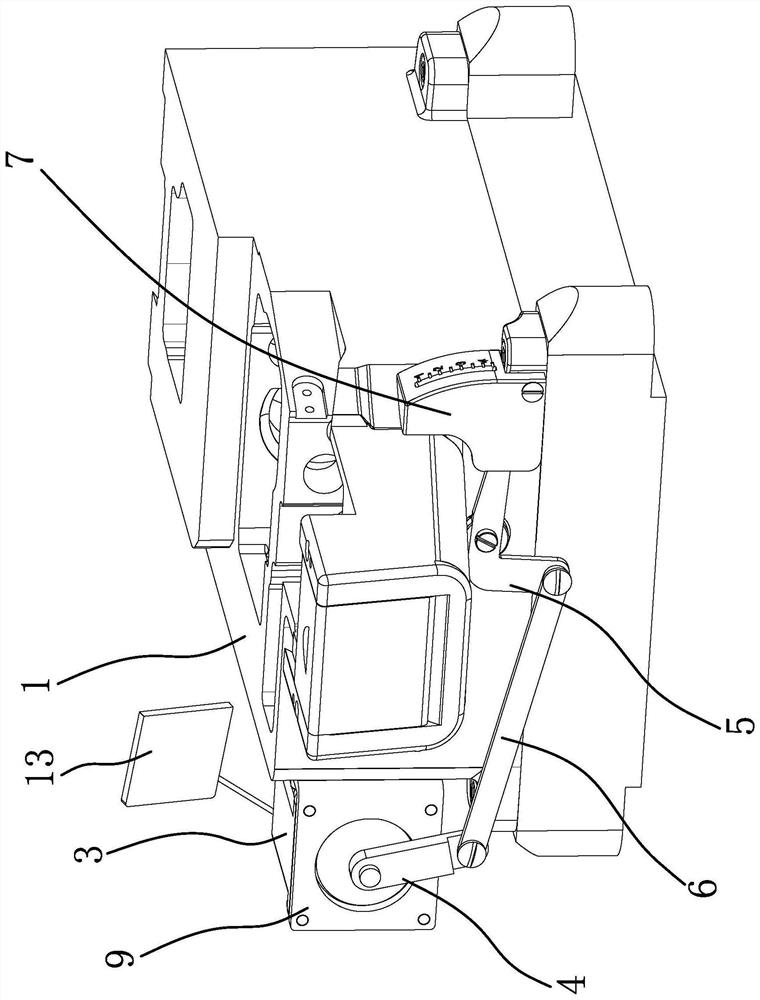
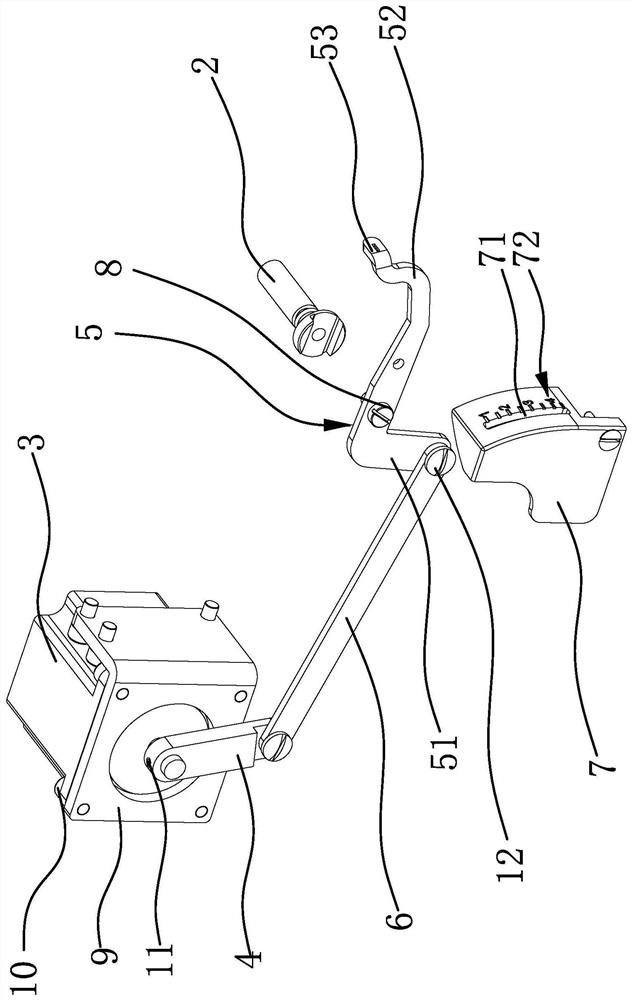
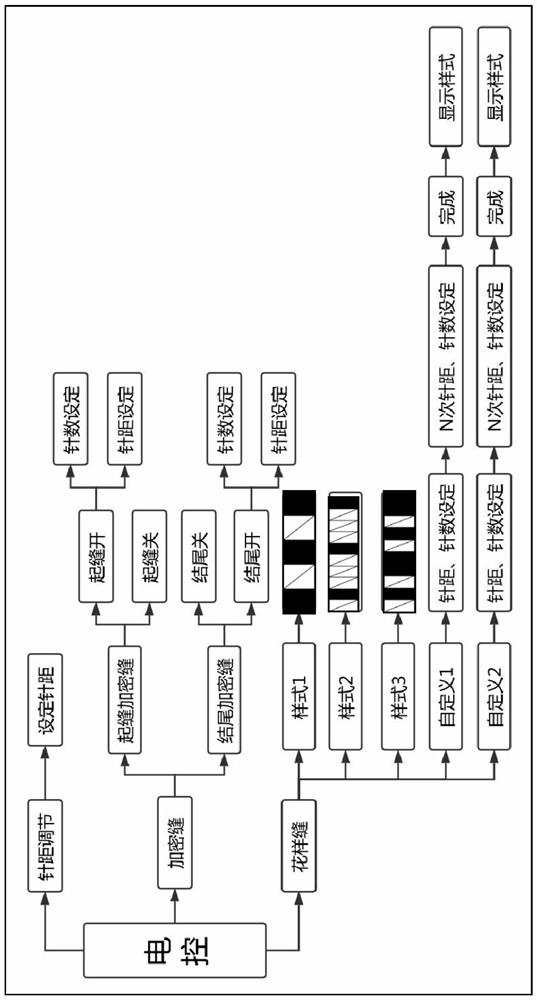
The invention provides a control and regulation method of stitch length for sewing machinery, belongs to the technical field of clothing manufacturing equipment and solves the technical problems that,for instance, stitch length regulation for existing sewing machinery has poor precision. A sewing machine comprises a housing, a feed dog, a driving motor arranged on the housing and a stitch lengthadjusting shaft which is rotatable. A rocking rod is fixed to an output shaft of the driving motor; the end of the stitch length adjusting shaft is fixedly connected with a rocking crank; the rockingrod is connected with one end of the rocking crank through a rocking connection rod; a stitch length graduated plate having graduation is fixed to the housing; the other end of the rocking crank corresponds to the graduation of the stitch length graduated plate. The control and regulation method herein allows stitch length to be regulated easily and front and rear thicker sewing to be performed via the screwing machine, and allows some simple pattern sewing to be achieved through an electronic control system.


Owner:JACK SEWING MASCH CO LTD
DC microgrid branch linkage control system and method
ActiveCN112582992AAccurate fault judgmentEfficient and reliable controlEmergency protective circuit arrangementsFault location by conductor typesEngineeringControl system
The invention provides a DC microgrid branch linkage control system and method. The DC micro-grid branch linkage control system comprises a detection unit for performing real-time voltage detection and current detection on each branch connected to a DC micro-grid bus; a controller which is used for carrying out frequency analysis and threshold analysis on the detected voltage and current, judgingfaults occurring in the direct-current microgrid on the basis of the frequency analysis and the threshold analysis, and carrying out linkage control on a plurality of branches on the basis of the faults; and a branch linkage mechanism which is used for executing linkage protection on branches in the system under the control of the controller.


Owner:BEIJING ETECHWIN ELECTRIC
Reach Truck
ActiveUS20150100210A1Easy to controlEasy to operateAnalogue computers for trafficLifting devicesEngineeringTruck
Reach truck 1 with a control system 2 for controlling the lowering movement of a fork 10, the control system 2 comprising a height sensor 20, for determining the lifting height h of the fork 10 of the reach truck 1, a proportional electrical hydraulic valve 50 connected to a lifting cylinder 70 of the reach truck 1, for controlling an oil flow of the lifting cylinder 70, and a control unit 30, connected to the height sensor 20 for receiving the actual lifting height h signal and controlling the proportional electrical hydraulic valve 50, wherein the control unit 30 automatically decreases the maximum lowering speed v of the fork 10, by controlling the proportional electrical hydraulic valve 50, according a predetermined maximum speed v curve depending on the lifting height h of the fork 10, and in some embodiments only on the lifting height h of the fork 10, such that the fork 10 is softly stopped at the ground.


Owner:HYSTER YALE GRP
A resonant power electronic converter and converter device
ActiveCN103441691BAchieving two-way flowReduce switching lossesEfficient power electronics conversionAc-dc conversionTransformerSmart grid
The invention relates to the technical field of power electronic converters, and aims to provide a resonant power electronic converter and a converter device. The converter includes an input-stage rectifier circuit and a subsequent DC / DC circuit. The input-stage rectifier circuit includes three bridge arms, and each bridge arm is composed of upper and lower half-bridge arms. The midpoints of each bridge arm are respectively connected to The three-phase connection of the high-voltage AC power grid; each half bridge arm includes n module units, and the ports of each module unit are connected end to end to form a bridge arm structure. The high-frequency isolation of the input and output sides of the present invention eliminates the bulky low-frequency transformer, and realizes high-efficiency energy transmission and intelligent control at the same time. It can block the harmonic transfer between different power grids and the mutual influence of faults. At the same time, the output voltage range is very wide, and the continuous adjustment of current and voltage can be realized. Moreover, the collection of operating information of the converter system is simple and convenient. Multiple converter systems They can communicate with each other to realize smart grid.


Owner:ZHEJIANG UNIV
Path generation and motion control method for shunt stacking machine
ActiveCN110727241ASimple configurationImprove execution efficiencyTotal factory controlNumerical controlControl orientedPathPing
The invention discloses a path generation and motion control method for a shunt stacking machine, which is applied to the control of the shunt stacking machine and a turnout shunting mechanism. Systemhardware consists of a vehicle-mounted PLC (Programmable Logic Controller), a conveying line PLC, a walking addressing device, a walking driving device, a shunt driving device and a shunt in-place sensor. The control method comprises a shunt path generating method, a path conflict detecting method, a shunt command generating method, and a turnout controlling and path state detecting method. The control method generates a path based on a generation tree, and realizes control oriented to the path, so that the program design and interaction data are simplified greatly, and modular design of thestacking machine and the turnout shunting mechanism is realized. Interaction between an upper computer and a lower computer is reduced, and the shunting operation efficiency is improved remarkably.


Owner:苏州新施诺半导体设备有限公司
A six-way valve
ActiveCN111322432BHighly integratedSimple control logicMultiple way valvesValve housingsEngineeringCommunication control


Owner:DUNAN ENVIRONMENT TECH
Effective load control and processing system facing satellite
ActiveCN106803770AEfficient and reliable controlImprove reliabilityError preventionRadio transmissionOperational systemIntermediate frequency
The present invention provides an effective load control and processing system facing a satellite. The system comprises: a power supply module configured convert a 28V primary source to a positive 5V power supply for the usage of other function modules and realizing the cold-hot switching according to an external instruction, a first control module and a second control module configured to be responsible for the control realization of the effective load control and processing system facing a satellite, a main processing module configured to perform integration processing of digital signals and cold-hot backups, and a first preprocessing module, a second preprocessing module and a third preprocessing module which are configured to perform preprocessing of the intermediate-frequency signals and perform hot backups. The effective load control and processing system facing the satellite has high reliability and radiation hardening index and has high anti-single event effect capacity and the single event effect protection function, supports the real-time operation system and common communication interfaces and control interfaces of a plurality of loads, and has the functions of control, communication, remote measurement, redundancy backup and application software, etc.


Owner:NO 32 RES INST OF CHINA ELECTRONICS TECH GRP
Six-way valve
ActiveCN111322432AHighly integratedSimple control logicMultiple way valvesValve housingsEngineeringControl switch
The invention relates to a six-way valve which comprises a valve body and a valve element arranged in a cavity of the valve body. Six branch pipelines are connected to the valve body, and each branchpipeline is communicated with the cavity in the valve body; the valve body can rotate relative to the valve body, the valve element comprises two valve clacks which are arranged in a spaced mode, three independent cavities are defined by the two valve clacks and the valve body, and the valve element rotates relative to the valve body to switch communication of the different cavities and the branchpipelines. According to the six-way valve, switching among three passages formed by the six branch pipelines on the valve body and the three cavities on the valve element is achieved through rotationof the valve element in the valve body, the six-way valve is high in integration degree and simple in control logic, communication control over the six branch pipelines on the valve body is simplified, and control is efficient and reliable; and meanwhile, the six-way valve is small in overall size, light in weight and low in energy consumption required for correspondingly controlling switching ofthe passages on the six-way valve.


Owner:DUNAN ENVIRONMENT TECH
A path generation and motion control method for a transfer stacker
ActiveCN110727241BSimple configurationImprove execution efficiencyTotal factory controlNumerical controlPathPingPath generation
The invention discloses a path generation and motion control method of a rail transfer stacker, which is applied to the control of a rail transfer stacker and a turnout mechanism. The system hardware is composed of vehicle-mounted PLC, conveyor line PLC, walking address recognition device, traveling driving device, track changing driving device, and track changing in-position sensor. The control method includes four parts: the generation method of the transition path, the detection method of the path conflict, the generation method of the transition command, the control of the turnout and the detection method of the path state. The method that the present invention proposes. The control method of the invention is based on the spanning tree to generate the path, realizes the control facing the path, greatly simplifies the program design and interactive data, and realizes the modular design of the stacker and the turnout mechanism. The interaction between the upper and lower computers is reduced, and the efficiency of the transfer operation is significantly improved.


Owner:苏州新施诺半导体设备有限公司
Frost-less air-source heat pump hot water unit and proportional-integral-differential control method for same
InactiveCN103245151BExtended service lifeSmooth and continuous adjustmentFluid heatersCorrosion preventionProportional integral differentialEngineering
The invention discloses a frost-less air-source heat pump hot water unit and a proportional-integral-differential control method for the same. The proportional-integral-differential control method includes performing computation according to received air temperature and humidity parameters, received air pressure parameters and received surface temperature parameters of an evaporator when outdoor temperature parameters which are transmitted by a temperature and humidity sensor and are received by a computation controller are lower than 0 DEG C, controlling the opening of an electronic expansion valve according to a computation result and regulating the surface temperature of the evaporator by means of increasing or reducing the opening of the electronic expansion valve so that the surface temperature of the evaporator is constantly higher than a frost formation point; and enabling a silicon-controlled power regulator to judge a suction superheat degree of a compressor according to received suction temperature and suction pressure of the compressor, increasing or reducing the power of an electric heater and maintaining that the suction superheat degree of the compressor only varies within a set value range. The frost-less air-source heat pump hot water unit and the proportional-integral-differential control method have the advantage that adjustment for the opening of the electronic expansion valve is matched with adjustment for the power of the electronic heater, so that the purpose of maintaining safe and efficient running of a system is achieved.


Owner:NANJING NORMAL UNIVERSITY +1
Method to control a hybrid powertrain, vehicle comprising such a hybrid powertrain, computer program to control such a hybrid powertrain, and a computer program product comprising program code
ActiveUS20170282701A1Easy transferPromote regenerationHybrid vehiclesElectric propulsion mountingInternal combustion engineControl theory
A method is provided to control a hybrid powertrain comprising an internal combustion engine; a gearbox with input and output shafts; a range gearbox connected to the output shaft; a first planetary gear, connected to the input shaft; a second planetary gear, connected to the first planetary gear; first and second electrical machines, respectivley connected to the first and second planetary gears; a gear pair connected with the first planetary gear and the output shaft; and a gear pair, connected with the second planetary gear and the output shaft, wherein the internal combustion engine is connected to the input shaft. The method comprises: a) engaging a gear by connecting two rotatable components in the first planetary gear; b) connecting the second or the fourth gear pair; c) connecting a sixth gear pair, arranged between a countershaft and the range gearbox to the countershaft, so that the countershaft is connected with the output shaft via the range gearbox; d) synchronising the rotational speed between two rotatable components in the range gearbox; e) connecting the rotatable components with a shiftable third clutch device; and f) engaging a gear by way of connecting two rotatable components in the second planetary gear.


Owner:SCANIA CV AB
SIM card control circuit for single-chip dual-mode mobile terminal
ActiveCN101478840BEfficient and reliable controlReduce the numberWireless communicationComputer hardwareVirtual switch
The invention discloses an SIM card control circuit of a single-chip dual-mode mobile terminal, which also comprises a virtual switch; a first power lead foot VCC of a first SIM card and a second power lead foot VCC of a second SIM card are respectively connected with the power lead foot VSIM of the SIM card controller; a first grounding lead foot GND of the first SIM card and a second grounding lead foot GND of the second SIM card are respectively connected with the grounding lead foot GND of the SIM card controller. The circuit and the method of the invention realizes automatically exclusive reading-writing of two SIM cards on the single-chip dual-mode mobile terminal under a set of SIM card control chips through employing some hardware devices and software control.


Owner:SHANGHAI WINGTECH ELECTRONICS TECH
Electromagnetic device for manipulating a magnetic-responsive robotic device
ActiveUS20200357554A1Strong magnetic fieldStrong gradientTransformers/reacts mounting/support/suspensionElectromagnets without armaturesEngineeringMechanical engineering
An electromagnetic device for manipulating a magnetic-responsive robotic device, and an electromagnetic apparatus incorporate one or more such electromagnetic device. The electromagnetic device includes a magnetic core 200 having a first portion and a second portion extends from one side of the first portion. The first portion has a first cross section and defining a first central axis. The second portion has a second cross section smaller than the first cross section, and defines a second central axis parallel to the first central axis. A first electromagnetic coil is arranged around the first cylindrical portion. A second electromagnetic coil is arranged around the second cylindrical portion.


Owner:CITY UNIVERSITY OF HONG KONG
Power Distribution Switching Device
ActiveCN105244898BGuaranteed accuracyAvoid harmPolyphase network asymmetry elimination/reductionElectric switchesDistribution controlEngineering
The invention discloses a switchover device for power distribution, which comprises: a base, in which are provided an accommodation cavity, a support pad, a sliding plate, a follower of a control handle, and three relays corresponding to each phase line of a three-phase power supply line , the first terminals of the controlled ports of the three relays are used to connect the phase lines of the three-phase power supply lines respectively; the second terminals of the controlled ports of the three relays are used to connect to the single-phase power supply lines; The control coil is used to connect the power distribution controller to automatically switch the power distribution state; a mechanical anti-short circuit mechanism for interlocking the actions of the three relays is formed in the base. There is no need for the control delay caused by the confirmation of the electronic control logic by the power distribution controller, thus solving the contradiction between the control delay and the confirmation of the correctness of the control logic during the power supply switching process of the unbalanced three-phase load, and ensuring the correctness of the control logic In addition, the control delay caused by electronic detection during the power distribution switching process is omitted, and the control is reliable and efficient.


Owner:长沙高升电子电器科技有限公司
Single pipe grabbing control system under deep hypothermia cold chain environment
PendingCN114770582APrevent low temperature failureEfficient and reliable controlGripping headsDynamo-electric converter controlCold chainControl system
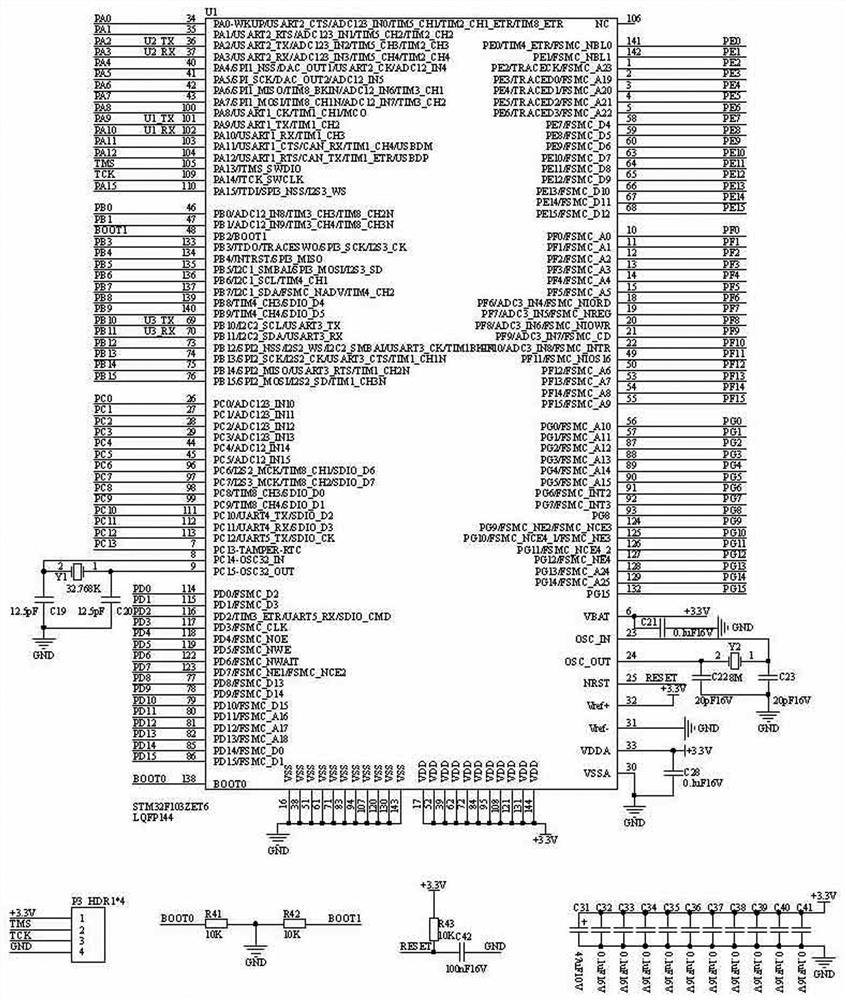
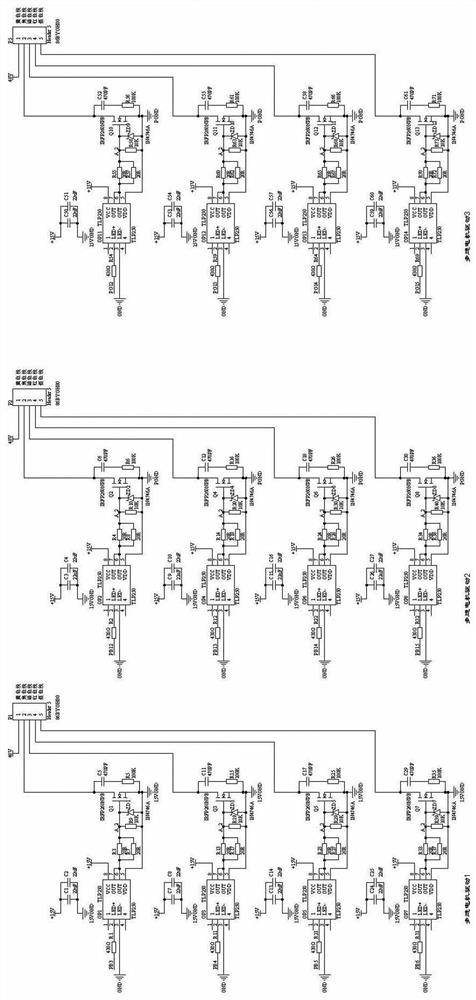
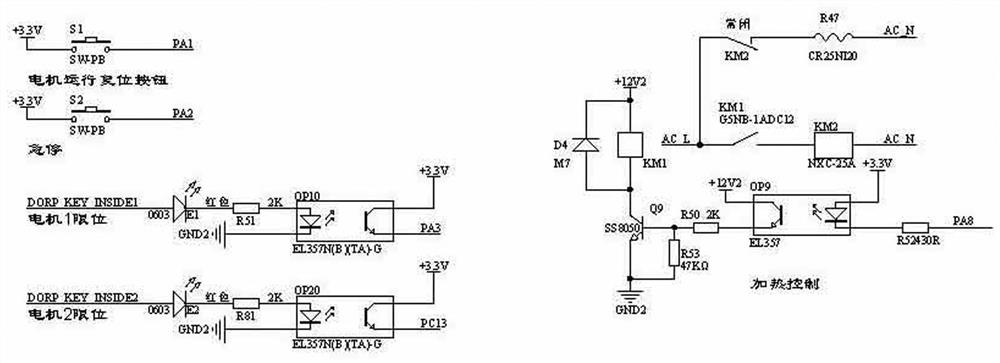
The invention belongs to the technical field of single pipe grabbing, and particularly relates to a single pipe grabbing control system in a profound hypothermia cold chain environment. The single pipe grabbing control system in the deep hypothermia cold chain environment is good in using effect. The single tube grabbing control system in the deep hypothermia cold chain environment comprises a processor circuit, a first stepping motor driving circuit, a second stepping motor driving circuit, a third stepping motor driving circuit, a heating control circuit, a temperature detection circuit and a power supply circuit. The control circuit is characterized in that a signal transmission port of the processor circuit is respectively connected with a signal transmission port of the first stepping motor driving circuit, a signal transmission port of the second stepping motor driving circuit, a signal transmission port of the third stepping motor driving circuit, a signal transmission port of the heating control circuit and a signal transmission port of the temperature detection circuit.
Owner:SUZHOU ITANKA TECH CO LTD
Distribution switching apparatus
ActiveCN105244898AGuaranteed accuracyAvoid harmPolyphase network asymmetry elimination/reductionElectric switchesControl delaySlide plate
The invention discloses a distribution switching apparatus comprising a pedestal. An accommodation cavity, a support pad, a slide plate, followers of control handles, and three relays corresponding to all phase lines of a three-phase power supply circuit are arranged in the pedestal. First terminals of controlled ports of the three relays are connected with all phase lines of the three-phase power supply circuit; second terminals of the controlled ports of the three relays are connected to a power supply single-phase circuit jointly; and control coils of the three relays are connected with a distribution controller to realize automatic distribution state conversion. Besides, a mechanical anti-short-circuit mechanism for carrying out interlocking on motions of the three relays is arranged inside the pedestal. A phenomenon that the distribution controller needs determination from electronic control logic and thus control is delayed can be avoided, so that conflict between delayed control and control logic correctness determination during the power supply switching process of three-phase load unbalanced can be eliminated. Therefore, correctness of the control logic can be guaranteed and control delay caused by electronic detection during the distribution switching process can be prevented; and the control can be realized reliably and efficiently.


Owner:长沙高升电子电器科技有限公司
Full-digital control system based on safe high-speed autonomous bus
ActiveCN113071648AEfficient and reliable controlEfficient and reliable measurementPower plants using nuclear energyPropulsion based emission reductionFast algorithmDigital control


Owner:CHINA SHIP DEV & DESIGN CENT
Enciphered seam adjusting structure of sewing machine
InactiveCN109930305AReduce adjustmentReduce the difficulty of operationWork-feeding meansSewing-machine control devicesMachine partsElectric machinery
The invention provides an enciphered seam adjusting structure of a sewing machine and belongs to the technical field of clothing manufacturing equipment. The structure solves the technical problems that the enciphered seam adjusting structure of a prior sewing machine is not accurate enough and the like. The enciphered seam adjusting structure comprises a shell, a cloth feeding rack, cloth feedingteeth, a differential tooth rack and differential teeth, wherein the enciphered seam adjusting structure comprises a lower front shaft and a differential shaft which are connected with the differential tooth rack and the cloth feeding rack; the enciphered seam adjusting structure also comprises a driving motor arranged in the shell; an output shaft of the driving motor is connected with a connecting rod pin through a swinging rod assembly; the lower front shaft is connected with the connecting rod pin through an eccentric connecting rod; and the differential shaft is connected with the connecting rod pin through a connecting crank and a crank connecting rod. According to the invention, the number of the enciphered stitches and the distances between the enciphered stitches are accurately controlled through the driving motor, and manual adjustment of mechanical parts is not needed, so that the operation requirement of a user is greatly reduced; and moreover, the speed response is high,the adjustment is convenient, the control is efficient and reliable, and the automation degree is high.


Owner:JACK SEWING MASCH CO LTD
A deformable observation device for a deep sea underwater observation platform
ActiveCN107416157BImprove observation effectFlexible means of observationUnderwater vesselsHydrodynamic/hydrostatic featuresOcean observationsOcean observation
The invention discloses a deformable observation device of a deep-sea underwater observation platform, and belongs to the field of deep-sea underwater observation. A pair of horizontal wings which can be deformed through rotating by an angle are arranged on the body of an underwater observation platform main body. The main structure is arranged inside a pressure-resistant shell, and a streamline fairing is externally arranged to improve the hydrodynamic performance. By combining complicated and changeable deep sea observation requirements and the characteristics of existing mainstream ocean observation equipment, the deformable observation device realizes switchover among multiple hydrodynamic profiles of the platform by adopting the active deformation of the platform horizontal wings, and the platform can be embodied with three typical observation modes, namely, the horizontal maneuvering mode, the vertical fixed-point mode and the zigzag gliding mode. The deformable observation device has a plurality of observation modes and can complete the platform integration of multiple observation means such as points, lines and planes, thereby improving the comprehensive observation capability of the platform, and the deformable observation device has bright application prospects.


Owner:HUAZHONG UNIV OF SCI & TECH
A method for controlling and adjusting stitch distance on a sewing machine
ActiveCN109989185BAchieve regulationRealize front and rear dense seamsProgramme-controlled sewing machinesWork-feeding meansCrankControl engineering
The invention provides a method for controlling and adjusting the stitch distance on a sewing machine, which belongs to the technical field of garment manufacturing equipment. It solves the technical problems such as the inaccurate adjustment of the stitch distance of the existing sewing machine. The sewing machine includes a casing, a feed dog, a drive motor arranged on the casing, and a rotatable stitch length adjustment shaft. A swing rod is fixed on the output shaft of the drive motor, and a swing crank is fixedly connected to the end of the stitch length adjustment shaft. , the swing rod is connected with one end of the swing crank through the swing connecting rod, a needle distance scale plate with scale value is fixed on the casing, and the other end of the swing crank corresponds to the scale value on the needle distance scale plate. The control and adjustment method in the present invention can easily realize the adjustment of the stitch distance and the front and rear dense seams of the sewing machine, and at the same time realize some simple pattern seams through the electric control system.
Owner:JACK SEWING MASCH CO LTD
A cross-platform mobile network terminal control method and system thereof
ActiveCN102685254BSolve remote business processingEfficient and reliable controlSubstation equipmentTransmissionNetwork terminationHTML5
The invention discloses a control method for a cross-platform mobile network terminal, which comprises the following steps of: S1, sending a request to a service terminal by a mobile network terminal; S2, generating a control code and sending to the mobile network terminal by the service terminal after receiving the request of the mobile network terminal, wherein the control code is used for controlling hardware equipment of the mobile network terminal, which is realized by using the techniques of HTML5, JavaScript and json; S3, receiving the control code from the service terminal by the mobile network terminal, executing the control code to control the hardware equipment of the mobile network terminal, and obtaining the parameters collected by the hardware equipment; S4, sending the parameters collected by the hardware equipment to the service terminal by the mobile network terminal; and S5, receiving the parameters collected by the hardware equipment by the service terminal and interacting with the database of the service terminal for business processing. The method disclosed by the invnetion realizes control of different mobile network platforms with lower cost.


Owner:SHENZHEN POWERSOFT TECH
Satellite Payload Control and Processing System
ActiveCN106803770BEfficient and reliable controlImprove reliabilityError preventionRadio transmissionCommunication interfaceControl communications


Owner:NO 32 RES INST OF CHINA ELECTRONICS TECH GRP
Direct current chain voltage control method of permanent magnet synchronous motor system without electrolytic capacitor
ActiveCN119315885AImprove torque control accuracyReduce capacity requirementsElectronic commutation motor controlElectric motor controlCapacitanceVoltage vector
The invention discloses a direct current chain voltage control method for a permanent magnet synchronous motor system without an electrolytic capacitor, and the method comprises the steps: constructing a minimum bus voltage based on an expected voltage vector angle in real time according to the maximum output capability of a space vector modulation link and an output expected voltage vector; when the output voltage of the rectifier is lower than the minimum bus voltage, the power switch device in the direct-current chain is switched on immediately, so that the thin-film capacitor is switched into the direct-current chain, the insufficient output voltage of the rectifier is compensated by utilizing the voltage of the thin-film capacitor, and the direct-current chain voltage is always higher than the minimum bus voltage. The contradiction between reduction of the capacitance value of the direct-current chain thin-film capacitor and high-performance control of the driving system is effectively solved; under the condition that the space vector modulation technology is applied, the direct current link voltage stability of the permanent magnet synchronous motor system without the electrolytic capacitor in high-performance operation can be ensured, and therefore efficient and reliable control over the driving system is achieved.

Owner:ZHEJIANG UNIV ADVANCED ELECTRICAL EQUIP INNOVATION CENT
Friction test system, computer-implemented friction test method for rail vehicle, computer program and non-volatile data carrier
PendingCN119053492AEliminate uneven distributionComfort is not compromisedElectric devicesBraking action transmissionControl signalControl cell
In a rail vehicle (100), a control unit (140) controls a set of braking / traction units (101, 161; 102) by control signals (B1, A1, B2, A2, B3, A3, B4, A4). 102, 162; 103, 163; 104, 164) to apply a respective braking / traction force to a respective axle (131, 132, 133, 134) to decelerate / accelerate the rail vehicle (100). The control unit (140) obtains a first wheel speed signal ([omega] 1) indicative of a rotational speed of at least one first wheel (121) and obtains a second wheel speed signal ([omega] a) indicative of an average rotational speed of at least one second wheel (122, 123, 124). The control unit (140) generates a first control signal (BF; BF) for the first braking / traction unit (101, 161). A1) such that the unit applies a gradually increasing braking / traction force to the first axle (131) until the first and second wheel speed signals ([omega] 1; the absolute difference (| [omega] 1-[omega] a |) between [omega] a) exceeds a threshold value. The control signal is generated such that an average braking / traction force applied to the at least one second axle (132, 133, 134) gradually decreases when the braking / traction force applied to the first axle (131) gradually increases. In response to an absolute difference (| [omega] 1-[omega] a |) exceeding a threshold value, the control unit (140) determines a parameter ([mu] m) reflecting a coefficient of friction ([mu] e) between the wheels (121, 122, 123, 124) and a set of rails (181, 182) on which the rail vehicle (100) travels.

Owner:DELLNER BRAKES AB